
The November 2026 Adult LEGO Buying Guide
An adult LEGO set can be a relaxing build, a centerpiece, or the next step in a collection. The best choice depends on how much you want to spend, what kind of building you enjoy, and where the finished model will live. Start with those constraints before browsing box art or comparing scores.
This guide uses five examples from the DisplayGrade catalog to show how those tradeoffs change across price and display size. The listed prices below are the catalog's retail-price values, not live retailer offers. Catalog facts and shopping details can change, so open each set page and current deals before ordering.



Set a budget and a collecting goal
Choose a comfortable ceiling before you shop. Include tax and any display costs in that number: a deeper shelf, a stable riser, cabinet lighting, or a case can matter as much as the box. Decide whether your goal is one satisfying build, a particular theme, a new shape for an existing shelf, or a centerpiece you have been planning for a while. A clear goal makes it easier to compare very different sets without treating the largest one as the automatic winner.
The kidult collecting guide can help you think through what you want a collection to do for you. Browse the full catalog once you have a rough spending range and a role in mind. Keep a little room in the budget for the rest of the display rather than spending the entire amount on the set itself.
Compare build and display commitments
Piece count helps set expectations, but it is not a reliable clock. Sorting habits, building pace, and how often you pause all affect the experience. Think about whether you enjoy a long project or would rather finish over a few evenings. The skill-level guide offers another way to consider build challenge, though a category or score cannot tell you exactly how a particular build will feel.
Display footprint matters just as much. Check width, depth, and height on the set page, then measure the usable shelf space and leave clearance for dusting and lifting the model into place. The catalog's size band is a quick filter, not a substitute for the actual dimensions. The shelf-fit guide has a step-by-step measuring approach. If two candidates still seem close, put them in the comparison tool and review their details side by side.
Five catalog picks across different budgets
A compact arrangement: Orchid
The Orchid is a Botanical set with a catalog retail price of $49.99. Its listing records a 2021 release, 608 pieces, and a DisplayGrade of 84. The built model measures 18 × 18 × 23 cm, weighs 0.54 kg, and sits in the compact band. It can be a lower-cost way to add a small display object, though compact does not mean it will suit every shelf: check the height and leave enough room around the stems. Compare its shape with the Wildflower Bouquet if you want a botanical subject and have more horizontal space to use.
A focused botanical display: Wildflower Bouquet
The Wildflower Bouquet is in the Botanical theme. Its catalog retail price is $59.99; the listing records a 2022 release, 939 pieces, and a DisplayGrade of 88. The built model measures 40 × 13 × 36 cm, weighs 0.65 kg, and sits in the mid-size band. That long, narrow shape may suit a console or a shelf where you want a vertical arrangement without giving up much depth. Measure the full 40 cm length, and consider whether its colors and form add something distinct to the models you already display.
A low, long vehicle: Bugatti Bolide
The Bugatti Bolide is a Technic model with a catalog retail price of $69.99. Its listing shows a 2023 release, 905 pieces, and a DisplayGrade of 78. At 48 × 21 × 14 cm and 1.60 kg, it is in the mid-size band: relatively low, but long enough to need an uninterrupted shelf. It is a useful comparison if you are choosing between a decorative subject and a vehicle-focused build. Check that the shape and theme interest you, then review the skill-level guide and detail page for more context.
A substantial centerpiece: Lion Knights Castle
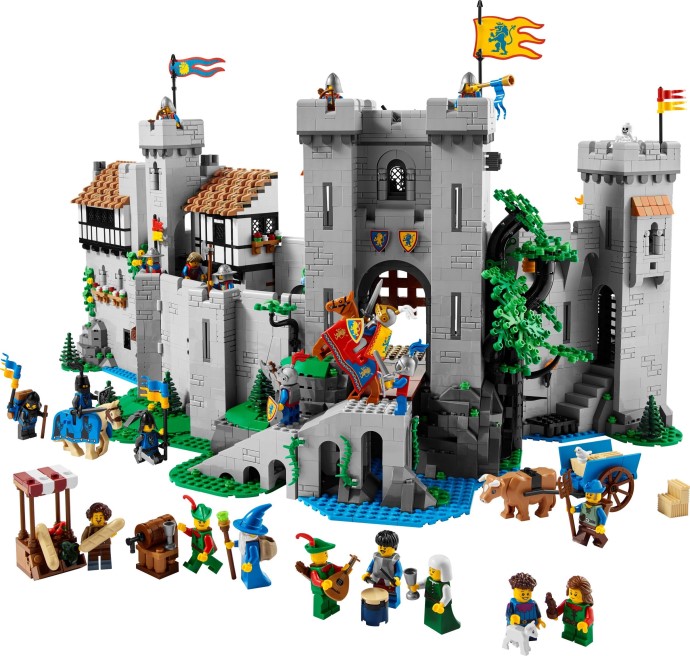
The Lion Knights Castle is an Icons set listed at $399.99 retail. The catalog records a 2022 release, 4,514 pieces, and a DisplayGrade of 91. Its 55 × 37 × 53 cm dimensions and 2.90 kg weight place it in the statement band. That is a meaningful commitment in both money and shelf depth: make sure you have a stable location and enough room to view the model from the angles you care about. If its medieval theme would fill a gap in your collection, compare it with other candidates before stretching your budget for a higher score or a larger box.
A broad science-fiction display: AT-AT
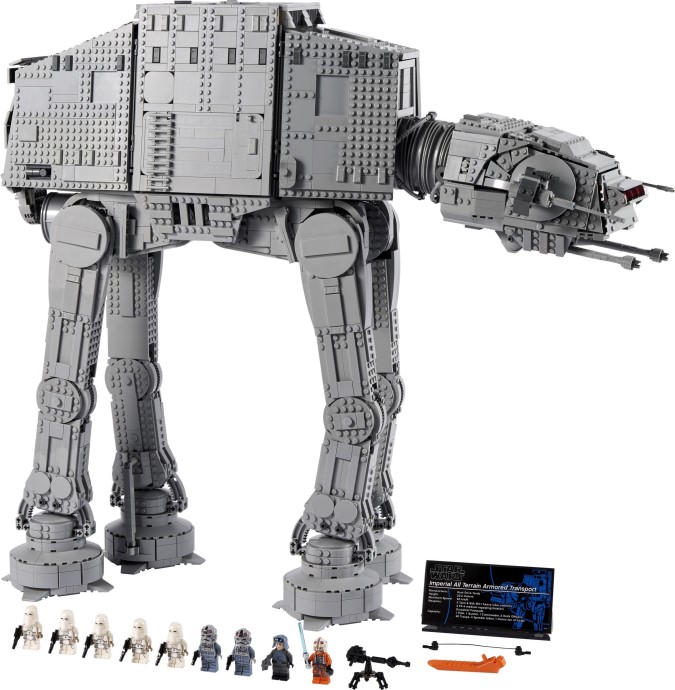
The AT-AT has a catalog retail price of $849.99. Its Star Wars listing records a 2021 release, 6,785 pieces, a DisplayGrade of 94, and dimensions of 110 × 60 × 27 cm. The longest axis gives it a showpiece band, despite its relatively low 27 cm height. Plan around its broad footprint and listed 7.50 kg weight, and confirm the furniture can carry it securely. For a Star Wars collector who has the room and budget, it is a very different kind of commitment from a tall landmark.
These examples show why scores and piece counts need context. The DisplayGrade value is one comparison signal in the catalog; it is not a verdict on your personal taste, building enjoyment, or collection. A lower-scoring set can be the stronger personal choice when its subject, proportions, budget, or display role fit you better. The scores help you organize candidates, while your own priorities decide between them.
Check live shopping details
Retail prices in the catalog are useful for planning a broad budget, but they do not tell you today's retailer offer or stock status. Set pages and deals show changeable shopping information, so check them close to the time you buy. Compare the retailer, shipping terms, and final checkout total. Avoid making a decision based on an old screenshot or a price copied into a saved note.
You can also use the comparison tool to narrow two finalists, then revisit their detail pages for dimensions and images. If a candidate is above your ceiling or does not fit, return to the catalog and look for another set that fills the same role. Waiting, choosing a different theme, or setting aside money for a future purchase are all reasonable collecting decisions.
Purchase checklist
- Set a ceiling — include tax and any shelf, riser, or display case costs.
- Name the role — decide what the set adds to your collection and why you want to build it.
- Measure the display spot — check width, depth, height, clearance, and the route for moving the model.
- Review the full dimensions and size band — use the catalog band to filter, then plan with each actual axis.
- Match the build to your time and interests — use piece count, set details, and the skill-level guide as context.
- Compare plausible alternatives — use Compare when two options meet the same goal.
- Check current offers — open the live set page and deals for retailer price, stock, and terms.
- Confirm the display is ready — check shelf stability and make room to place, clean, and enjoy the finished model.
Further reading
For a broader collector-planning approach, read the October 2026 Collector Guide to Adult LEGO. Continue with the kidult guide, browse all sets, and use the shelf-fit guide before committing to a large display. When you are ready to shop, check deals for current details.
Choose the set that fits the budget you planned, the build you want to spend time on, and the space you can give it. A thoughtful match will be easier to enjoy long after the box is put away.